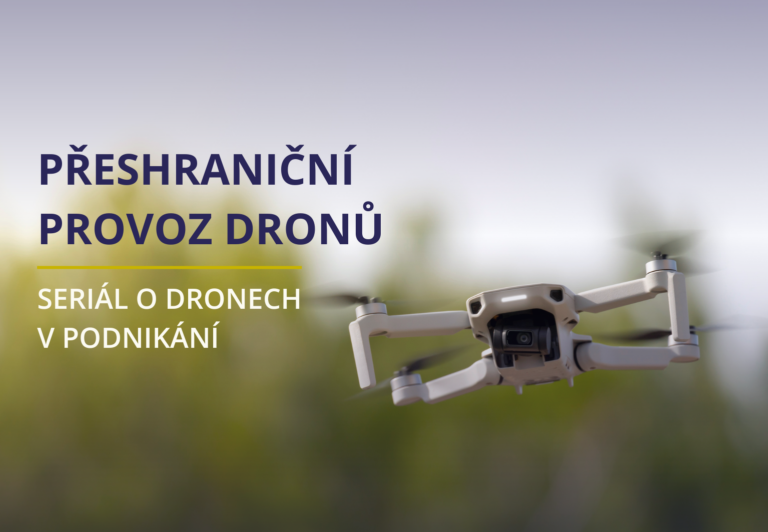
Unmanned aerial vehicles, often referred to as drones, are gaining increasing attention not only in the Czech Republic but also across the European Union. With their growing popularity, there are more and more cases where operators want to carry out flights outside the Member State in which they are registered. The reason may be for vacation, business trip or provision of services abroad.
What are they? basic rules for cross-border drone operations within the European Union? What should you look out for if you start your flight in the Czech Republic and continue in another EU member state? What are the differences in the legal regulations of individual member states? You can find out all about this in our article.
Legal regulation
The operation of unmanned systems is largely harmonised in the Member States of the European Union. This is done through two main directly applicable regulations – Commission Regulation (EU) 2019/947 on rules and procedures for the operation of unmanned aircraft (hereinafter "Regulation (EU) 2019/947") a Commission Regulation (EU) 2019/945 on unmanned aerial systems and third country operators of unmanned aerial systems (hereinafter "Regulation (EU) 2019/945"). It is these regulations that create a uniform basis for the operation of drones in the European Union. However, we must take into account some of the peculiarities of specific national regulations, as unification in this area is not complete.
Non-EU countries
The same rules for the operation of unmanned systems also apply in some non-member states that are part of the European Free Trade Association (EFTA) and at the same time participate in the European Union Aviation Safety Agency (EASA) system based on their relations with the European Union. These are: Switzerland, Norway, Iceland and Liechtenstein.
A unified European drone operation system
Regulation (EU) 2019/947 divides the operation of unmanned systems into three categories according to the level of risk – open, specific and certified. The open category is the least risky, while the certified category is the most risky.
Traffic in the open category It does not require any operating permit or declaration of operation before it can be carried out. (Of course, other requirements for the open category such as registration, compliance with operating rules, etc. must be taken into account.)
In a specific category An operating permit issued by the competent authority, a permit from model aircraft clubs and associations, or a declaration from the operator of unmanned systems is required.
In the certified category An unmanned system certificate under Regulation (EU) 2019/945, an operator certificate and, where applicable, a remote pilot licence are required.
Operator registration
Operators of unmanned systems are required to register under certain conditions. In the specific category, registration is mandatory if they operate an unmanned aircraft of any weight. For operations in the open category, operators must register if they operate:
- unmanned aircraft with a maximum take-off weight of 250 g or more,
- an unmanned aircraft that, in the event of a collision, can transfer kinetic energy of more than 80 joules to a person, or
- an unmanned aircraft that is equipped with a sensor capable of capturing personal data, unless it complies with Directive 2009/48/EC on the safety of toys.
In the case of the operation of these drones within the territory of the European Union, it is sufficient single registration, which is carried out in the Member State of residence of the operator or in the Member State where the operator has its principal place of business. Multiple registrations in several States are not permitted. After registration, operators will receive a unique digital registration number that will allow for individual identification. Operators must visibly display the assigned registration number on all unmanned aircraft whose operation is subject to the registration obligation.
Recognition of qualifications
Apart from operator registration, there are mutual agreements within the European Union recognized také remote pilot certificate of competency issued under Regulation (EU) 2019/947. A pilot who has obtained a certificate in one Member State may also use his/her privileges when flying in other Member States of the European Union. It is not necessary to undergo additional training or take different tests in each Member State where the pilot plans to fly the unmanned system. However, it is important to comply with other conditions, especially the minimum age of the pilot..
It is advisable to have the certificate available during the flight itself so that it can be presented to the relevant authorities upon request.
Minimum age for pilots
The minimum age for a pilot is generally set in open and specific categories on 16 letHowever, Member States may lower the minimum age in their territory by up to 4 years in the open category and by up to 2 years in the specific category.
This option has not been used in the Czech Republic, Germany, Austria or Slovakia, so the standard age of 16 applies here.
For example, Poland and France have used this option and the minimum age is set at 14. However, this limit may not apply to all categories of operation and we recommend that you check in advance whether the minimum age limit for your planned flight is not higher.
This could mean that a child is allowed to fly a drone in one Member State, but is not allowed to fly a drone in another Member State due to not meeting the minimum age requirement. Meeting the minimum age requirement is a prerequisite for flying.
Exceptions
At the same time, there are exceptions where the minimum age requirement for remote pilots does not apply, namely:
- for operations in subcategory A1, with a class C0 unmanned system, in the event that it is a toy within the meaning of Directive 2009/48/EC,
- for privately built unmanned systems with a maximum take-off weight of less than 250 g,
- in the case of operation under the direct supervision of a remote pilot who meets the minimum age and other specified requirements.
Prohibited zones
European legislation gives Member States the possibility to define geographical zones for the purpose of safety and environmental protection or critical infrastructure. In these zones, States may prohibit the operation of unmanned systems, require prior authorisation for operation, allow access only to certain unmanned systems or impose other restrictions. It is therefore essential to check before each flight in a new area whether it will take place in a prohibited or restricted zone.
These zones can be checked using digital maps or information systems made available by individual Member States. Digital maps usually contain interactive features and specific information on prohibitions and restrictions. It is worth keeping an eye not only on digital maps Czech Republic and neighboring states, so Slovenska, in Germany, Poland a Austria.
It is in the case of prohibited zones that significant differences between national regulations can occur, and pilots may be unpleasantly surprised by prohibitions or restrictions in other countries, especially in specially protected areas.
Liability from cross-border traffic
In the case of cross-border traffic, it is appropriate to draw attention to the issue of liability. As a rule, violations of traffic rules will be assessed according to the legal system of the state in whose territory the violation occurredOperators and pilots should take into account that individual states may regulate administrative offenses and sanctions related to drone operations differently.
Violations of the rules may result in fines of varying amounts, bans on activities, or other sanctions according to the legal system of the state in whose territory the violation occurred.
Insurance
In addition to administrative liability, liability for damage may also arise, the resolution of which in cross-border cases is often administratively and financially demanding. Therefore, it is advisable to arrange liability insurance for damage caused by the operation of unmanned systems, even in cases where it is not required.
The legal regulations on insurance vary from one Member State to another, so it is advisable to familiarise yourself with the rules of the country in which you plan to fly. In the Czech Republic, insurance is not required if it is an individual recreational or sports operation of an unmanned aircraft with a maximum take-off weight of up to 20 kg, otherwise insurance is required. On the contrary, in Germany, insurance is generally mandatory.
When negotiating, it is important to include in the contract terms verify in particular the territorial scope of the insurance coverage, i.e. whether your insurance also covers insured events that occur abroad.
Protection of personal data in cross-border drone operations
Last but not least, it is necessary to take into account that the operation of drones may involve the taking of photographs, videos and other recordings containing personal data. It is therefore necessary to comply with the provisions of the Member States privacy policy according to Regulation (EC) No 2016/679 of the European Parliament and of the Council (General Data Protection Regulation).
Cross-border drone operations in a specific category
When operating in a specific category, the following applies: different rules than in the open category. The fact that an operator has received an operating authorisation from the competent authority of the Member State of its registration does not in itself mean that it can carry out the same operation without further ado in the territory of another Member State..
Before commencing operations in a specific category in another Member State, the operator is required to submit a copy of its operating authorisation to the competent authority of that State, together with information on the planned operations. The host Member State will then assess the submitted documents and may impose further conditions for operations on its territory. Only then can operations be carried out.
Given that the length of administrative processes is not the same in all Member States, it is advisable to start preparing for cross-border operations in a specific category with sufficient time.
Summary
Although drone operations are largely unified within the European Union, it is necessary to pay attention to the specificities of national legislation. European regulation ensures mutual recognition of operator registration and remote pilot qualifications, but at the same time leaves room for member states to regulate themselves. This is particularly evident in determining the minimum age of pilots or defining prohibited zones for flights with unmanned systems.
Before flying in another member state, every drone operator should therefore familiarize themselves not only with the European regulations, but also with the legal requirements at the national level. Knowledge of local restricted zones is very important.
When operating unmanned systems outside the European Union member states and other states involved in the EASA regulatory framework, the requirements for registration, qualification and operation itself may differ significantly. Before flying in these countries, it is necessary to familiarize yourself with the specific legal regulations in order to avoid possible sanctions. Last but not least, it is necessary to take into account that the categories of operation themselves may differ significantly from those in Europe.
Source: epravo.cz
Do you need legal advice regarding cross-border drone operations in the EU? Or do you need to address a more general issue from air law? Contact us, we are the best in the industry!

JUDr. Ing. Jan Vych, attorney and partner

Mgr. Lucie Špičková, Attorney

Nikol Zlámalová, Paralegal